


Page 99 - Sonbeel Utsab 2024
P. 99
Salmostoma bacaila, Nandus nandus, Eutropiichthys vacha, Ompok bimaculatus,
               Clupisoma  garua,  Alia  coila,  Peudeutropius  atherinoides  are  dramatically
               decreasing in the recent decades.
               Avifaunal diversity
                      A total of 89 species of birds belonging to 32 families were recorded from
               Sone Beel, where 39 were water birds, 13 were water-dependent birds, and 37 were
               terrestrial birds. Sixty species are residents of the
               wetland,  27  winter  visitors,  one  species,  i.e.,
               Black-headed Ibis, was a local migrant and one
               species,  i.e.,  Indian  Plaintive  Cuckoo,  was  a
               summer migrant. Among the bird species, lesser
               Adjutant  and  Pallas's  Fish  Eagle  are  listed  as
               vulnerable and endangered in the International
               Union for Conservation of Nature (IUCN) red list
               categories. At the same time, Black-headed Ibis,
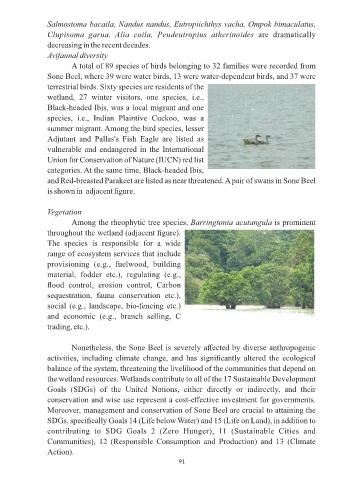
               and Red-breasted Parakeet are listed as near threatened. A pair of swans in Sone Beel
               is shown in  adjacent figure.

               Vegetation
                      Among the rheophytic tree species, Barringtonia acutangula is prominent
               throughout the wetland (adjacent figure).
               The  species  is  responsible  for  a  wide
               range of ecosystem services that include
               provisioning  (e.g.,  fuelwood,  building
               material,  fodder  etc.),  regulating  (e.g.,
               flood  control,  erosion  control,  Carbon
               sequestration,  fauna  conservation  etc.),
               social (e.g., landscape, bio-fencing etc.)
               and  economic  (e.g.,  branch  selling,  C
               trading, etc.).


                      Nonetheless, the Sone Beel is severely affected by diverse anthropogenic
               activities,  including  climate  change,  and  has  significantly  altered  the  ecological
               balance of the system, threatening the livelihood of the communities that depend on
               the wetland resources. Wetlands contribute to all of the 17 Sustainable Development
               Goals  (SDGs)  of  the  United  Nations,  either  directly  or  indirectly,  and  their
               conservation and wise use represent a cost-effective investment for governments.
               Moreover, management and conservation of Sone Beel are crucial to attaining the
               SDGs, specifically Goals 14 (Life below Water) and 15 (Life on Land), in addition to
               contributing  to  SDG  Goals  2  (Zero  Hunger),  11  (Sustainable  Cities  and
               Communities),  12  (Responsible  Consumption  and  Production)  and  13  (Climate
               Action).
                                                      91

