


Page 84 - Sonbeel Utsab 2024
P. 84
Power and energy
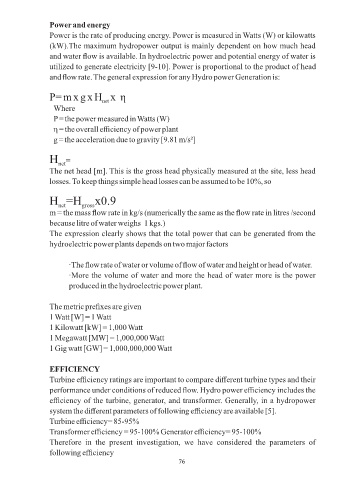
                Power is the rate of producing energy. Power is measured in Watts (W) or kilowatts
                (kW).The maximum hydropower output is mainly dependent on how much head
                and water flow is available. In hydroelectric power and potential energy of water is
                utilized to generate electricity [9-10]. Power is proportional to the product of head
                and flow rate. The general expression for any Hydro power Generation is:

                P= m x g x H  x  η
                               net
                 Where
                 P = the power measured in Watts (W)
                 η = the overall efficiency of power plant
                 g = the acceleration due to gravity [9.81 m/s²]


                H =
                  net

                The net head [m]. This is the gross head physically measured at the site, less head
                losses. To keep things simple head losses can be assumed to be 10%, so

                H =H         x0.9
                  net    gross
                m = the mass flow rate in kg/s (numerically the same as the flow rate in litres /second
                because litre of water weighs  1 kgs.)
                The expression clearly shows that the total power that can be generated from the
                hydroelectric power plants depends on two major factors


                     ·The flow rate of water or volume of flow of water and height or head of water.
                     ·More the volume of water and more the head of water more is the power
                     produced in the hydroelectric power plant.


                The metric prefixes are given
                1 Watt [W] = 1 Watt
                1 Kilowatt [kW] = 1,000 Watt
                1 Megawatt [MW] = 1,000,000 Watt
                1 Gig watt [GW] = 1,000,000,000 Watt


                EFFICIENCY
                Turbine efficiency ratings are important to compare different turbine types and their
                performance under conditions of reduced flow. Hydro power efficiency includes the
                efficiency of the turbine, generator, and transformer. Generally, in a hydropower
                system the different parameters of following efficiency are available [5].
                Turbine efficiency= 85-95%
                Transformer efficiency = 95-100% Generator efficiency= 95-100%
                Therefore  in  the  present  investigation,  we  have  considered  the  parameters  of
                following efficiency
                                                      76

